

Though dead, they say Nikiphoros still doth live.
For the righteous live, even when they have died.
On the first of May, O Nikiphoros, thou didst depart.
He was born around 1750 in Kardamyla of Chios, and his family name was George. Having fallen ill with the plague at a young age and being saved, he was dedicated by his parents to the Panagia of Nea Moni, that he might serve Her. After he regained his health, they brought him to the monastery, where he first served under Anthimos of the Holy Fathers. Later, he was sent to Chora to be educated in the schools there. Upon completing his studies, he returned to the monastery and was ordained a hierodeacon; subsequently, he was appointed as a teacher in the schools of Chora and simultaneously served as a preacher.
While serving as a teacher, he was called by the state to the abbotcy of Nea Moni. He laboured zealously to come to the aid of the monastery’s interests, to reconcile differences, and to smooth over the general situation through his modest, fair judgment and uprightness, offering the most essential service within the monastery: the elevation of the moral spirit of those within it, providing himself as the first emulatable example. However, when he grew weary of toiling and enduring affairs foreign to his nature, and especially when he grew weary of being beaten down by the ingratitude of those around and beneath him, he fled before the end of the two-year period of his abbotcy to Resta. There he went to his friend, the Hieromonk and teacher Joseph, to be close to Saint Macarius Notaras.
With them, several new martyrs stayed and were taught perseverance in the Christian Faith. Among them was the Holy New Martyr Demetrius of the Peloponnese, who was martyred in 1803 in Tripolitsa of Arcadia, and whom Nikiphoros confessed while he was there. Others included the Holy New Martyr Mark and the Holy New Martyr Angelis, who visited Nikiphoros before his martyrdom. It was also with Nikiphoros that Saint Athanasius of Paros spent the short remaining time of his life. In 1819, he published in Venice the Neon Leimonarion (The New Meadow), containing the lives and services of the New Martyrs.
The saint remained in Resta for approximately twenty years. He greatly improved the estate of Resta, occupying himself with it throughout his entire stay. So greatly did the peasants revere him—especially those of Kardamyla—and such confidence did they have in him, that they would beseech him during times of drought to intercede with God. His good intercession was almost always readily accepted, and the people rejoiced and were exceedingly glad.
He very frequently went to the city and the villages, sometimes visiting the sick, sometimes preaching the word of God. Even as an old man, he did not hesitate but hastened to those in need. It is recorded in the life of Saint Macarius that he was once sought from Kallimasia by a sick woman, but he was not found at the residence in Chora. They hurried there and found him on the road, returning to Chora. They told him the reason, and upon hearing it, he turned back towards the suffering woman, though he was already exhausted, it being the ninth hour of the night. He healed the suffering woman immediately by placing a relic of Saint Macarius upon her.
But he himself also worked many miracles of his own. One was performed on a demoniac in Vrontados. On another occasion, when fiery stones were falling from the sky, he was called to perform a blessing of the waters at the parish of Saint George in Vrontados to put an end to the calamity; while the blessing was being performed, one of these stones fell into the holy water and was instantly extinguished, and this was the last one to fall.
Yet again, on another occasion when he was away on a journey, his only goat was stolen. The saint calmed his weeping disciple, saying: “Do not be angry, for he who stole it must be poor.” No sooner had he said this than the thief arrived weeping and confessed his wicked deed, adding that he had slaughtered the goat but found it impossible to sell the meat. The Saint forgave him and told him that he would now be able to sell the meat, which indeed came to pass. It is also well known that he foresaw and foretold impending terrible events.
His goodness and compassion were also wondrous. He distributed all the money he acquired from time to time to help the needy, remaining poor himself. He never gave alms himself, but through a trusted child.
Another man, Nicholas Lodes from Vrontados, who was suffering terribly, frequently called upon the saint. One night he saw him in his sleep, instructing him to go and take earth from his grave. Having done this, he was healed.
Apolytikion (Troparion) – Tone 4
(To the melody “As an angel in the flesh…”)
Thou wast shown forth, O Nikiphoros, as a most radiant star of the Church of Christ, a most bountiful meadow of His truth, and a trumpet flowing with honey, who dost sweeten the hearts of the faithful with divine streams from on high. Wherefore, intercede with Christ our God, that our souls may be saved.
Kontakion – Tone 4
(To the melody “Today the Virgin…”)
Today all Chios doth honour Nikiphoros, who, having courageously taken up the Cross of Jesus, draweth the Orthodox unto salvation; and who, chanting now with the righteous and the saints, doth offer up glory in odes, chants, and hymns to God in the highest.
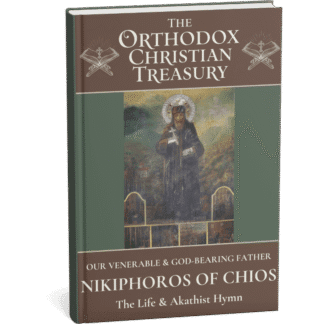
Go Beyond the Synaxarion: A Guiding Star for Troubled Times
The account above is a brief glimpse into the life of a spiritual giant of the Kollyvades. In an age where the pure teachings of the Holy Fathers are often forgotten, arm your soul with the life-giving antidote of True Orthodoxy through our exclusive translation of the life of St. Nikiphoros of Chios.
- First English Translation: Faithfully translated from the authentic 1907 Greek text, featuring rich translator’s notes that unlock the deep historical and monastic context of his life.
- New True Orthodox Akathist: An original, soul-stirring hymn composed by our monastery, invoking his protection as a pillar of the Kollyvades renewal against Western innovation.
- Beautiful Digital Editions: Receive a lovingly designed, full-colour PDF for your prayer corner, alongside a reflowable EPUB for all e-readers.


