Posted on

The Recovery of the Relics of St. Athanasios the Great (May 2)

An icon of St. Athanasius the Great.

Encomiastic verses for the feast:1

Athanasios, whither art thou borne?

Do they send thee forth again, an exile even in death?

On the second, the relic of Athanasios was brought in.

Other encomiastic verses unto the great one:

Arius, be silent; by silence hast thou been condemned,

While the wise Athanasios crieth out:

Vile babbler, vessel of malice,

Old sophist of Satan’s sophistries,

Hide thyself now, being full of much shame;

For the words of Athanasios shine,

Words as if from the mouth of the August Trinity,

And they reach everywhere like lightning bolts,

Burning thy friends or even thy heart,

From whence, having taken a beginning

To introduce the corruption of rotten doctrines, O deceiver,

Thou wast slung away by the sling of the Spirit;

Truly thou wast struck by the divine arrows,

Truly thou wast smitten by the fatal bolts,

Which, in a most godly manner, were hurled

By the fiery tongue of Athanasios.

O most shameful and wretched one of abomination,

Truly thou hast paid a worthy penalty,

Thine entrails having been loosened, but justly,

Leaving thy soul in the midst of dung-filled places.

But O divine servant, sacrificer for God,

Athanasios, fount of wise words,

Thou thirteenth initiate of the Word,

Thou fire-formed mind, thou divine mouth,

Thou second Elias of Arius’,

Thou tenth rank of the divine bodiless powers,

If it be lawful to say this—O strange wonder—

Whose words truly prove to be

All-delightful rose-gardens of the theologians,

Most excellent, light-formed, golden-flowered lilies,

Treasuries and heirlooms of heavenly things,

In harmony with the ineffable blessings of the angels,

They gush forth the sweet wine of truly divine love;

For they are an entirely insatiable sweetness,

And an unutterable joy to those filled therewith;

Bright bridal chambers of the mortals who have desired them,

Myrrh-breathing, fiery pillars of sacrifice,

A great propitiation for those under the sun,

A wealth, a coronet, a lightning-fashioned chariot,

Swords against enemies, helpers, protection,

Gold-flowing rivers of theology,

Light-bearing stones, glorious pearls,

The glory and beauty of the bodiless powers,

The joy of angels and archangels,

Noetic manna, food of the New Israel,

Nectar, reward, boast, thrones of the Lord,

Opener of the gates of the Sion above,

Lifting up the mind clothed in glory

Unto the Thrice-radiant and Only King;

To Whom is due glory unto all the ages. Amen.

Apolytikion (Troparion), Tone 3

(To the melody: “Of the divine faith”)

Thou hast become a pillar of Orthodoxy, upholding the Church with divine dogmas, O Hierarch Athanasius; for by proclaiming the Son to be co-essential with the Father, thou didst put Arius to shame. Holy Father, entreat Christ God to grant us great mercy.

Kontakion, Tone 2

(To the melody: “In the flood of thy blood”)

Having planted the dogmas of Orthodoxy, thou didst cut down the thorns of error, multiplying the seed of the Faith by the downpour of the Spirit, O Holy One; wherefore we hymn thee, Athanasius.

Megalynarion

Thou wast revealed as a golden trumpet of Orthodoxy, O Hierarch, proclaiming the Son and the Holy Spirit to be co-essential with the Father; wherefore we magnify thee, Athanasius.

1 Translated from The Service for the Translation of the Relics of Our Father Among the Saints, Athanasius the Great, Patriarch Of Alexandria (Printing House Of Aristomenes Z. Dialismas, 1908, Athens), which says the service is “gleaned from the manuscripts of the Monastery of the Iberians on the Holy Mountain.” These verses are read between and the 6th and 7th odes of the orthros (matins) canon, in place of the synaxarion reading.


Vigil Lamp Oil Offering

Light a Vigil Lamp for a Day

In times past, the faithful brought olive oil to fuel the vigil lamps at our monastery. Today, as that tradition fades, the responsibility falls to our small brotherhood.

An offering of just $3 keeps one vigil lamp burning for a full day.


Light a Vigil Lamp

Posted on

Our Venerable Father Nikiphoros of Chios (May 1)

An icon of St. Nikiphoros of Chios.

Though dead, they say Nikiphoros still doth live.
For the righteous live, even when they have died.
On the first of May, O Nikiphoros, thou didst depart.

He was born around 1750 in Kardamyla of Chios, and his family name was George. Having fallen ill with the plague at a young age and being saved, he was dedicated by his parents to the Panagia of Nea Moni, that he might serve Her. After he regained his health, they brought him to the monastery, where he first served under Anthimos of the Holy Fathers. Later, he was sent to Chora to be educated in the schools there. Upon completing his studies, he returned to the monastery and was ordained a hierodeacon; subsequently, he was appointed as a teacher in the schools of Chora and simultaneously served as a preacher.

While serving as a teacher, he was called by the state to the abbotcy of Nea Moni. He laboured zealously to come to the aid of the monastery’s interests, to reconcile differences, and to smooth over the general situation through his modest, fair judgment and uprightness, offering the most essential service within the monastery: the elevation of the moral spirit of those within it, providing himself as the first emulatable example. However, when he grew weary of toiling and enduring affairs foreign to his nature, and especially when he grew weary of being beaten down by the ingratitude of those around and beneath him, he fled before the end of the two-year period of his abbotcy to Resta. There he went to his friend, the Hieromonk and teacher Joseph, to be close to Saint Macarius Notaras.

With them, several new martyrs stayed and were taught perseverance in the Christian Faith. Among them was the Holy New Martyr Demetrius of the Peloponnese, who was martyred in 1803 in Tripolitsa of Arcadia, and whom Nikiphoros confessed while he was there. Others included the Holy New Martyr Mark and the Holy New Martyr Angelis, who visited Nikiphoros before his martyrdom. It was also with Nikiphoros that Saint Athanasius of Paros spent the short remaining time of his life. In 1819, he published in Venice the Neon Leimonarion (The New Meadow), containing the lives and services of the New Martyrs.

The saint remained in Resta for approximately twenty years. He greatly improved the estate of Resta, occupying himself with it throughout his entire stay. So greatly did the peasants revere him—especially those of Kardamyla—and such confidence did they have in him, that they would beseech him during times of drought to intercede with God. His good intercession was almost always readily accepted, and the people rejoiced and were exceedingly glad.

He very frequently went to the city and the villages, sometimes visiting the sick, sometimes preaching the word of God. Even as an old man, he did not hesitate but hastened to those in need. It is recorded in the life of Saint Macarius that he was once sought from Kallimasia by a sick woman, but he was not found at the residence in Chora. They hurried there and found him on the road, returning to Chora. They told him the reason, and upon hearing it, he turned back towards the suffering woman, though he was already exhausted, it being the ninth hour of the night. He healed the suffering woman immediately by placing a relic of Saint Macarius upon her.

But he himself also worked many miracles of his own. One was performed on a demoniac in Vrontados. On another occasion, when fiery stones were falling from the sky, he was called to perform a blessing of the waters at the parish of Saint George in Vrontados to put an end to the calamity; while the blessing was being performed, one of these stones fell into the holy water and was instantly extinguished, and this was the last one to fall.

Yet again, on another occasion when he was away on a journey, his only goat was stolen. The saint calmed his weeping disciple, saying: “Do not be angry, for he who stole it must be poor.” No sooner had he said this than the thief arrived weeping and confessed his wicked deed, adding that he had slaughtered the goat but found it impossible to sell the meat. The Saint forgave him and told him that he would now be able to sell the meat, which indeed came to pass. It is also well known that he foresaw and foretold impending terrible events.

His goodness and compassion were also wondrous. He distributed all the money he acquired from time to time to help the needy, remaining poor himself. He never gave alms himself, but through a trusted child.

Another man, Nicholas Lodes from Vrontados, who was suffering terribly, frequently called upon the saint. One night he saw him in his sleep, instructing him to go and take earth from his grave. Having done this, he was healed.

Apolytikion (Troparion) – Tone 4

(To the melody “As an angel in the flesh…”)

Thou wast shown forth, O Nikiphoros, as a most radiant star of the Church of Christ, a most bountiful meadow of His truth, and a trumpet flowing with honey, who dost sweeten the hearts of the faithful with divine streams from on high. Wherefore, intercede with Christ our God, that our souls may be saved.

Kontakion – Tone 4

(To the melody “Today the Virgin…”)

Today all Chios doth honour Nikiphoros, who, having courageously taken up the Cross of Jesus, draweth the Orthodox unto salvation; and who, chanting now with the righteous and the saints, doth offer up glory in odes, chants, and hymns to God in the highest.

Go Beyond the Synaxarion: A Guiding Star for Troubled Times

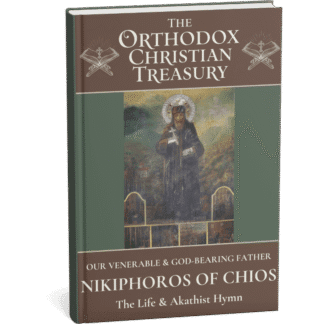
The account above is a brief glimpse into the life of a spiritual giant of the Kollyvades. In an age where the pure teachings of the Holy Fathers are often forgotten, arm your soul with the life-giving antidote of True Orthodoxy through our exclusive translation of the life of St. Nikiphoros of Chios.

  • First English Translation: Faithfully translated from the authentic 1907 Greek text, featuring rich translator’s notes that unlock the deep historical and monastic context of his life.
  • New True Orthodox Akathist: An original, soul-stirring hymn composed by our monastery, invoking his protection as a pillar of the Kollyvades renewal against Western innovation.
  • Beautiful Digital Editions: Receive a lovingly designed, full-colour PDF for your prayer corner, alongside a reflowable EPUB for all e-readers.

Purchase the Digital Edition

Posted on

St. Panaretos of Paphos (May 1)

An Icon of St Panaretos of Paphos.

Having drawn all virtue to himself,
Panaretos confirms his name by his deeds.

Saint Panaretos was born at the beginning of the eighteenth century, most probably in Peristeronopigi of Famagusta, where he also became a monk in the local Monastery of Saint Anastasius. We know that in the year 1764 he was the abbot of the Monastery of the Panagia in Pallouriotissa. He ascended the throne of Paphos in 1767 and served as its Hierarch until 1790, when he fell asleep in the Lord.

He lived during those difficult years of the Turkish occupation, a time when fear overshadowed all things and the yoke of slavery weighed heavily. Despite the lack of schools and free education at the time, he was able to acquire a broad education through his own personal efforts and by attending schools maintained by the monasteries. He possessed a broad intellect, which he combined with a strict ascetic life that he diligently concealed. He lived frugally and without luxury, like the poorest Cypriot of his time. He kept vigil for many hours in prayer. He went to confession with humility and celebrated the divine services with sacred dignity. Knowing full well that a man’s greatest victory is to conquer himself—namely, his passions and weaknesses—and in order to remember that the people entrusted to him by God were heavily chained in Turkish slavery, he wore upon his body a brass and an iron chain. By sanctifying himself through the Grace of God, he offered the greatest help to his flock.

As a Metropolitan, he so loved his people that he attended to the problems of all with exceptional care. He utilised both spiritual and material goods in an Orthodox manner, with balance, to the glory of God. He guided the people towards theosis; he celebrated the liturgy, pastored, taught, laboured, and created.

He had a special devotion to Saint Philip (commemorated on the 14th of November) and commissioned a silver reliquary for the Saint’s skull, which is found today in Omodos. At his own expense, an icon of the Apostle Philip was painted. He undertook the expenses for the erection of the church of the Monastery of Saint Anastasius in Peristeronopigi and the painting of the icons for its iconostasis. He renovated the churches in Nikokleia, Drousia, Drymou, Arodes, Theletra, Philousa Kelokedaron, and many other villages. He also renovated the monasteries of Chrysorrogiatissa (1770), the Holy Cross in Omodos, and the Holy Cross in Minthi.

Panaretos of Paphos fully undertook the costs for the publication of the work by the Athenian philosopher Theophilos Korydalleus, “On Generation and Corruption According to Aristotle” (1780). He also assisted financially in the publication of the book by Archimandrite Kyprianos, “A Chronological History of Cyprus” (1788). He was a friend of the Archbishop of Cyprus, Philotheos, who was a highly educated man. He participated in the writing and publication of synodal encyclicals during the tenure of Archbishop Chrysanthos. Owing to his efforts in 1774, local rulers were denounced to the Sultan for maladministration, and in 1783–1784 he travelled with the other Metropolitans to Constantinople, where they succeeded in having the tyrant Hadjibakkis dismissed by the Sultan.

He worked miracles while still in this life. His synaxarion records that he rebuked a priest—who was telling lies and swearing that he had not embezzled money—commanding him to be silent, and the man immediately became mute. Having fallen ill shortly before his death, the priest sent a letter, and his bishop went to him. After the priest repented and asked for forgiveness, his tongue was loosed.

The holy hierarch departed unto the Lord in 1790. Such was the virtue of the saint that he foresaw his death and dug his own grave in the place where the sanctuary of the Cathedral of Saint Theodore in Paphos is located today. He also foresaw that the former Bishop of Karpathos, Parthenios, had arrived at the port of Paphos; he sent for him and offered him hospitality. Parthenios then served his funeral on the very next day. He even became a witness to the healing of a poor paralytic, who had the bishop as his protector, at the very moment they were bringing the relics out from the Metropolis.

The saint had given instructions that he be buried in the garments he was wearing. However, out of love for his spiritual father, his protosyngellos disobeyed him for the first time, and it was then that the chains were discovered, which in certain places had embedded themselves into his flesh. The people of God recognised his holiness immediately after his death, and his official inclusion in the holy calendar of the Church of Cyprus took place during the days of the Cypriot Patriarch of Constantinople, Gerasimos III (1794–1797).

Apolytikion (Troparion), Tone Plagal 1 (5)

Let us praise and glorify the shepherd of Paphos, who lived ascetically in the city as on a mountain, and wisely acquired all the divine virtues as one. Wherefore, as Panaretos, he was shown by God to be wondrous unto the world; and as a God-inspired Hierarch, he fervently intercedeth with God on behalf of all.

Kontakion, Tone 2

Having thy mind illumined by the radiance of the Spirit, O most sacred one, thou wast revealed as a shepherd proven in deed. For through Him thou hast received the divine grace of wonders, and in very deed thou didst become Panaretos, receiving thy name from thy works.

Go Beyond the Synaxarion: The Hidden Life of St. Panaretos

The account above is a glimpse into the life of this “all-virtuous” hierarch. Our exclusive new translation of the saint’s full life reveals the astonishing secret asceticism of a bishop who bore iron chains beneath his vestments and rivalled the desert fathers in the heart of the city.

  • Original Translation: First English translation of his life from the rare 1869 Greek Eklogion.
  • New Akathist Hymn: A soul-stirring prayer composed by our monastery for True Orthodox use.
  • Beautiful Digital Editions: Receive both a richly adorned PDF and a versatile EPUB for all e-readers.

Purchase the Digital Edition — Instant Download

Posted on

Holy Prophet Jeremiah (May 1)

A fresco icon of the Holy Prophet Jeremiah.

The glorious and great Prophet Jeremiah, who prophesied to the people of Israel for forty and one years, was born in Anathoth, where his father Hilkiah was a priest. He distinguished himself as a teacher of love, instructing his fellow countrymen to extinguish the hatred nesting within their hearts and to extend their love even towards their enemies—namely the Chaldeans—to whom he recommended submission in order to avoid the horrors of war. Misunderstood and persecuted as a traitor to his country, he was vindicated by the subsequent capture of Jerusalem by Nebuchadnezzar, which fulfilled his prophecies. He survived the destruction of Jerusalem, over which he wrote his poignant lamentations. Thereafter, he fled to Taphnas in Egypt, where the Egyptians honoured him exceedingly, but he was wickedly put to death by stoning at the hands of his own countrymen.

By his holy intercessions, O Christ God, have mercy upon us and save us. Amen.

Apolytikion (Troparion) of the Prophet, Tone 2

As we celebrate the memory of thy Prophet Jeremiah, O Lord, through his intercessions we beseech Thee: save our souls.

Kontakion, Tone 3

Having purified thy radiant heart in spirit, O great prophet and martyr, O glorious Jeremiah, thou didst receive the gift of prophecy from on high, and didst cry aloud in the lands: Behold, our God, and no other shall be added unto Him, Who, being incarnate, hath appeared on earth.

Megalynarion

Let us extol with hymns the wise prophet-martyr Jeremiah, who was sanctified from his mother’s womb and lamented the fall of the people of the Lord.

Go Beyond the Synaxarion: The Full Life of St. Jeremiah

The synaxarion entry above is a window into the life of this great Prophet. Our exclusive new translation of St. Jeremiah’s full life invites you to journey into his divine calling, his bold rebukes to kings, and his unyielding love for God.

  • The Complete Life: Newly translated from the 19th-century Russian Lives of the Saints by St. Demetrius of Rostov.
  • A Canon for Devotion: A beautiful canon translated by our brotherhood directly from the Greek.
  • Read Anywhere: Instant access to both a beautifully formatted PDF and a versatile EPUB file for all e-readers.

Purchase the Digital Edition — Instant Download

Posted on

Holy New Martyr Mary (Maria) of Crete (May 1)

A beautiful sketch icon of the Holy New Martyr Maria (Mary) of Crete being crowned by two angels with a heavenly crown.

CELEBRATED MAY 1st

The fair-virgin New Martyr of the Faith, Maria, surnamed Methymopoula,1 was born in Kato Fourni2 of Meramvellou, Crete, of pious and honourable parents. A certain Turko-Albanian gendarme3 became enamoured of this most chaste maiden, and he exerted every effort to entice her into his abominable lust. Yet, the more he strove, the more the blessed Maria spurned him, regarding him as a repulsive demon and a villain. Therefore, unable to entice her, the impious and bloodthirsty descendant of Hagar resolved to punish her and wickedly put her to death; which indeed he accomplished by means of the arms he bore as a gendarme. Finding Maria one day upon a mulberry tree4 gathering leaves for the nourishment of silkworms, he fired upon her and mortally struck her in the heart. Thus did the all-beautiful bride of the Lord receive the crown of the contest, and, crowned, she departed to meet her longed-for Bridegroom in the heavenly bridal chamber.

Apolytikion (Troparion) – Tone Plagal 1 (Tone 5)

Thou didst keep well the Faith of the Trinity, and faithfully inscribing it with thy blood, thou didst escape all the snares of the enemy. Wherefore, thou didst contest steadfastly as a glorious virgin, O New Martyr Maria. Therefore we all honour thee, beseeching thine intercessions.

Kontakion – Plagal 4 (Tone 8)

Let us crown with melodies and songs the comely virgin among Christ’s steadfast ewe-lambs, Maria the Prize-bearer, who blossomed forth from Crete like a most fragrant flower; and as unto a most sweet garden of virgin maidens let us cry aloud: Rejoice, O newly-contesting Martyr.


1 The name means “the daughter of Methymakis.” It is derived from her father’s surname. In Crete, she is known as Maria Methymakis.

2 Literally “Lower Fourni.” A village in the Lasithi region of Crete, historically known for silk farming.

3 Hellenic: Chorophylax (Χωροφύλαξ). Literally, a “guard of the countryside.” An armed rural constable in the service of the Ottoman occupation.

4 The women of this region would physically climb into the sturdy boughs of the white mulberry trees to harvest sackfuls of leaves.


Vigil Lamp Oil Offering

Light a Vigil Lamp for a Day

In times past, the faithful brought olive oil to fuel the vigil lamps at our monastery. Today, as that tradition fades, the responsibility falls to our small brotherhood.

An offering of just $3 keeps one vigil lamp burning for a full day.

Light a Vigil Lamp

Posted on

Saint Batas of Persia (May 1)

The Passion of the Holy Hieromartyr Batas (+ 4th c.)1

Commemorated on the First of May

The Holy Hieromartyr Batas was from Persia. His ancestors were Christians, and he himself was raised in the Christian faith. Having reached the age of thirty, he left his father, mother, wife, and children, distributed his possessions to the poor, and, departing from his parental home, embraced the monastic life. Striving zealously in the monastic life, he desired to end his life by a martyr’s death. At that time, a persecution was raised against Christians, and when all the monks from that monastery where the saint was struggling had fled, he alone remained. Soon he was seized and brought for judgment before the governor of the city of Nisibis. The latter began to compel him to renounce Christ and worship the sun and fire, but the saint did not obey him, and boldly confessed Christ as the true God. For this, they bound his arms in such a way that from the intense strain, they were dislocated from their shoulder joints. After this, they began to drag the saint along the ground, all the while beating him over his entire body. The holy martyr, after all these torments, reposed for his faith in Christ, being beheaded by the sword.

Footnotes

1 Translated from St. Demetrius of Rostov, Lives of the Saints in Russian (1902-1916 ed.).

A Beautiful, Printable Version for You

The full text of this reading is available for free above.

For those who would like to save, print, or read this life on an e-reader, we have also created a beautifully formatted digital edition. It includes decorative graphics, color artwork, and is designed for easy reading. The A4-sized PDF is perfect for printing and use on large screens, while the EPUB is ideal for e-readers, phones, and tablet devices.

Enter your email below to receive this enhanced version and to subscribe to our monastery’s occasional newsletter. We send updates on new publications and other work from the monastery.

If the form is not visible below, please click here to open it in a new window.

Posted on

St. Isidora the Fool for Christ of Egypt (May 1)

Our Venerable Mother Isidora, Fool for Christ of Egypt (+ c. 365)

Commemorated May 1st

[In one of the women’s monasteries of Tabenna1 in Egypt], there was a certain virgin named Isidora. For Christ’s sake, she presented herself as a fool and one who was mad, having chosen this path of ascetic struggle out of her rare humility and self-abasement. The others held her in such contempt that they would not even eat with her, a thing which she accepted with joy. Serving in the kitchen, she fulfilled every obedience for all the sisters, like a submissive slave, ready for any service. This blessed one was, as it is said, the offscouring of the monastery and fulfilled in deed that which is written in the Holy Gospel: “Whosoever will be chief among you, let him be a slave unto all and a servant unto all” (cf. Matthew 20:26; Mark 10:43); and also: “If any man among you seemeth to be wise in this world, let him become a fool, that he may be wise” (1 Corinthians 3:18).

While the other virgins, having been tonsured, wore the koukoulion2 on their heads, her head was always covered with a ragged cloth. Out of four hundred sisters, not one ever saw her eating. She never sat at the trapeza,3 nor did she ever take for herself even a slice of bread, but was content with the crumbs she gathered from the floor after the meal, and with the dregs she washed from the vessels. She never wore shoes and, despite all the reproaches, abuse, and scorn that many directed at her, she never offended anyone nor showed the slightest murmur of complaint.

An angel appeared to the holy hermit Pitirim,4 a man renowned for his spiritual struggles who lived in Porphyrites,5 and said of the venerable Isidora: “Why do you pride yourself on your ascetic feats, as though you were truly pious, living in such a place? Do you wish to see a woman more pious than you? Go to the women’s Tabennese monastery and there you will find one who wears a cloth on her head—she is better than you. For she struggles amidst such a multitude, serves everyone in various ways and, though all despise her, in her heart she never departs from God. But you, sitting here having never lived in the world, allow your mind to wander through the cities.”

Rising from his place, the great Pitirim went to the Tabennese monastery and asked the superiors there to escort him to the women’s community. Having crossed the river, they received him with joy, as a man renowned among the fathers and who had reached a great age in his ascetic labours. When they had prayed, the great one expressed his wish to see all the sisters in person. All of them gathered, but one, Isidora, did not come. The holy Pitirim said, “Bring me all of them.”

When they answered him, “We are all here,” he said, “There is one missing whom the angel showed to me.”

Then they said, “We have one who is mad—she is in the kitchen.”

“Bring her also,” said the great one, “let me look upon her.”

They went to call her. But Isidora, understanding the matter, did not obey; perhaps she too had received a revelation. They brought her by force, saying, “The holy Pitirim wishes to see you.” For his name was famous.

When they had brought her, the great one saw her face and the ragged cloth on her head. He fell at her feet and said, “Bless me, Mother.”

And she, likewise falling at his feet, said, “You bless me, my lord!”

Seeing this, all were astounded and began to exclaim, “Abba! Do not shame yourself: she is mad!”

“You are the ones who are mad,” the holy elder replied, “for she is better than you and me—she is our mother, and I pray that I may be found equal to her on the Day of Judgement.”

Hearing this, they all fell at his feet with weeping, confessing how greatly they had grieved this holy one. One said, “I always laughed at her.” Another, “I mocked her humble appearance.” Another said, “I insulted her, while she remained silent.” And another, “I often poured slops on her.” One said, “I beat her.” Another, “I struck her with my fist.” In short, all of them confessed to some offence they had committed against her.

Having accepted their repentance, the holy Pitirim prayed for them together with her, and after greatly consoling the venerable handmaiden of Christ, he departed from the convent.

A few days later, this blessed one, unable to endure the glory, honour, and services which all the sisters began to offer her, and burdened by their apologies, secretly departed from the monastery. Where she went, where she hid herself, and where she reposed, no one knows to this day. Thus did this valiant, humble-minded, and blessed virgin struggle.

Troparion, Tone 3

Desiring the beauty of Christ, O thrice-blessed Mother, thou didst choose the swift way that leadeth unto Him, even that of humility. Wherefore, He revealed thee as a teacher of monastics and a paragon of imitation of Him. Therefore, with joy we cry aloud to thee: Rejoice, O all-blessed Isidora!

Kontakion, Tone 2

Yearning to attain the abode on high, O Mother, thou didst choose the swift path of humility, through which thou wast led to Christ as a glorious and pleasing fruit, O all-hymned Isidora, receiving incorruptible rewards.

Endnotes

1 Also known as Tabennisi, this was the site in Upper Egypt where St. Pachomius the Great founded the first coenobitic (i.e., communal) monastery in the early 4th century, establishing a new model for the monastic life.

2 Koukoulion: This is the traditional head-covering worn by Orthodox monastics of the “Great Schema,” the highest degree of monasticism. It typically veils the head, neck, shoulders, and upper back.

3 Trapeza: (Greek: τράπεζα, literally ‘table’). The term for the refectory, or dining hall, in an Orthodox monastery where the monastics share their common meal.

4 St. Pitirim (Pitiroun) of Egypt: A disciple of St. Anthony the Great, St. Pitirim is celebrated on November 29th.

5 A desert region and monastic settlement in Egypt, located near the Red Sea. Its name is derived from the porphyry quarries in the area.

A Beautiful, Printable Version for You

The full text of this reading is available for free above.

For those who would like to save, print, or read this life on an e-reader, we have also created a beautifully formatted digital edition. It includes decorative graphics, color artwork, and is designed for easy reading. The A4-sized PDF is perfect for printing and use on large screens, while the EPUB is ideal for e-readers, phones, and tablet devices.

Enter your email below to receive this enhanced version and to subscribe to our monastery’s occasional newsletter. We send updates on new publications and other work from the monastery.

If the form is not visible below, please click here to open it in a new window.

Posted on

Saint Philosophos of Alexandria (May 1)

The Holy Martyr Philosophos, Perfected by the Sword (+ 252)1

Commemorated on the First of May

O Philosophos, blessed in name and in deed,

Thou hast truly proven thyself a friend of wisdom.

This great martyr of Christ, Philosophos, was from the region of Alexandria, as was related concerning him by Anthony the Great among ascetics. He completed his martyrdom in the following way.

There was in Alexandria a most beautiful garden, full of delight and sensory charm. Into this garden the tyrant of that time commanded that an adorned couch be placed. Upon it, they laid this holy Philosophos on his back, and bound his hands and feet. Then they brought in a prostitute, who went to the saint. Not only did she attempt to incite the saint to a shameful act with indecent words, but she also embraced him with her defiled hands, and kissed him, and shamelessly touched him.

But the most noble combatant of the Lord, though he was bound, still found a way and a means to save himself from the snares of the prostitute. For first, he closed his eyes so that he would not see her. Then, he bit down upon his tongue with his teeth, and with the unbearable pain he experienced from biting his tongue, he caused the other senses of his body to remain insensible to pleasure. Then, filling his mouth with blood, he spat it upon the face and the garments of the unclean and defiled prostitute, who, seeing the blood flowing like a river, became frightened and drew back.

Having struggled in this manner, the one of great soul was not vanquished, but was victorious; he was preserved passionless by the grace of Christ. For this, he was later beheaded and departed as a crown-bearer to the heavens, where he rejoices with a joy that is eternal and ineffable.2

Footnotes

1 This Life is translated from The Synaxaristes of the Twelve Months of the Year, 3rd Edition, Athens, 1868.

2 The 1868 Synaxaristes includes the following editor’s note for its entry on St. Philosophos: This narrative is also found in the manuscript of the Paradise of the Fathers. In the Synaxaristes of the holy monastery of Dionysiou, the new Coenobium on Mount Athos, this Philosophos is named Justin. The words of Chrysostom, with which he praises the true philosopher, are fitting for this Philosophos: “For what,” he says, “is proper to a philosopher? Is it not to look down on money and glory, and to be superior to envy and every passion? … Such is the philosopher, such is his wealth: he has nothing, and yet he has all things; he has all things, and yet he has nothing.” (Homily 21 on the Epistle to the Ephesians). And Gregory the Theologian also said: “There is a plant in fable that flourishes when it is cut and strives against the blade; and, if one may speak paradoxically of a paradoxical thing, it lives by death, grows by being cut, and increases by being consumed. These things belong to myth and the autonomy of fiction; but to me, it seems the philosopher is clearly such a thing: he thrives in his sufferings, makes his afflictions the material of virtue, and is adorned by their opposites, neither being lifted up by the ‘weapons of righteousness on the right hand’, nor being bent by those ‘on the left’ (cf. 2 Corinthians 6:7), but remains the same man, though not always in the same circumstances; or rather, he is found to be even more proven, like gold in a furnace.” (Oration upon his return from the country). The martyr of Christ Niketas, who suffered under Decius, performed a similar deed. For he too was placed and bound upon a couch and was incited to carnal desire by a prostitute. Therefore, to escape the pleasure, he severed his tongue with his teeth and spat it in the prostitute’s face, as is recounted by Nikephoros [the 14th-century Church historian]. And thus he was victorious, the one who was truly true to his name (“Niketas” derives from nikē, the Greek word for “victory”). See also the eighth chapter of the Politikon Theatron (a 17th-century Greek moral anthology).

A Beautiful, Printable Version for You

The full text of this reading is available for free above.

For those who would like to save, print, or read this life on an e-reader, we have also created a beautifully formatted digital edition. It includes decorative graphics, color artwork, and is designed for easy reading. The A4-sized PDF is perfect for printing and use on large screens, while the EPUB is ideal for e-readers, phones, and tablet devices.

Enter your email below to receive this enhanced version and to subscribe to our monastery’s occasional newsletter. We send updates on new publications and other work from the monastery.

If the form is not visible below, please click here to open it in a new window.