Posted on

Our Venerable Father Nikiphoros of Chios (May 1)

An icon of St. Nikiphoros of Chios.

Though dead, they say Nikiphoros still doth live.
For the righteous live, even when they have died.
On the first of May, O Nikiphoros, thou didst depart.

He was born around 1750 in Kardamyla of Chios, and his family name was George. Having fallen ill with the plague at a young age and being saved, he was dedicated by his parents to the Panagia of Nea Moni, that he might serve Her. After he regained his health, they brought him to the monastery, where he first served under Anthimos of the Holy Fathers. Later, he was sent to Chora to be educated in the schools there. Upon completing his studies, he returned to the monastery and was ordained a hierodeacon; subsequently, he was appointed as a teacher in the schools of Chora and simultaneously served as a preacher.

While serving as a teacher, he was called by the state to the abbotcy of Nea Moni. He laboured zealously to come to the aid of the monastery’s interests, to reconcile differences, and to smooth over the general situation through his modest, fair judgment and uprightness, offering the most essential service within the monastery: the elevation of the moral spirit of those within it, providing himself as the first emulatable example. However, when he grew weary of toiling and enduring affairs foreign to his nature, and especially when he grew weary of being beaten down by the ingratitude of those around and beneath him, he fled before the end of the two-year period of his abbotcy to Resta. There he went to his friend, the Hieromonk and teacher Joseph, to be close to Saint Macarius Notaras.

With them, several new martyrs stayed and were taught perseverance in the Christian Faith. Among them was the Holy New Martyr Demetrius of the Peloponnese, who was martyred in 1803 in Tripolitsa of Arcadia, and whom Nikiphoros confessed while he was there. Others included the Holy New Martyr Mark and the Holy New Martyr Angelis, who visited Nikiphoros before his martyrdom. It was also with Nikiphoros that Saint Athanasius of Paros spent the short remaining time of his life. In 1819, he published in Venice the Neon Leimonarion (The New Meadow), containing the lives and services of the New Martyrs.

The saint remained in Resta for approximately twenty years. He greatly improved the estate of Resta, occupying himself with it throughout his entire stay. So greatly did the peasants revere him—especially those of Kardamyla—and such confidence did they have in him, that they would beseech him during times of drought to intercede with God. His good intercession was almost always readily accepted, and the people rejoiced and were exceedingly glad.

He very frequently went to the city and the villages, sometimes visiting the sick, sometimes preaching the word of God. Even as an old man, he did not hesitate but hastened to those in need. It is recorded in the life of Saint Macarius that he was once sought from Kallimasia by a sick woman, but he was not found at the residence in Chora. They hurried there and found him on the road, returning to Chora. They told him the reason, and upon hearing it, he turned back towards the suffering woman, though he was already exhausted, it being the ninth hour of the night. He healed the suffering woman immediately by placing a relic of Saint Macarius upon her.

But he himself also worked many miracles of his own. One was performed on a demoniac in Vrontados. On another occasion, when fiery stones were falling from the sky, he was called to perform a blessing of the waters at the parish of Saint George in Vrontados to put an end to the calamity; while the blessing was being performed, one of these stones fell into the holy water and was instantly extinguished, and this was the last one to fall.

Yet again, on another occasion when he was away on a journey, his only goat was stolen. The saint calmed his weeping disciple, saying: “Do not be angry, for he who stole it must be poor.” No sooner had he said this than the thief arrived weeping and confessed his wicked deed, adding that he had slaughtered the goat but found it impossible to sell the meat. The Saint forgave him and told him that he would now be able to sell the meat, which indeed came to pass. It is also well known that he foresaw and foretold impending terrible events.

His goodness and compassion were also wondrous. He distributed all the money he acquired from time to time to help the needy, remaining poor himself. He never gave alms himself, but through a trusted child.

Another man, Nicholas Lodes from Vrontados, who was suffering terribly, frequently called upon the saint. One night he saw him in his sleep, instructing him to go and take earth from his grave. Having done this, he was healed.

Apolytikion (Troparion) – Tone 4

(To the melody “As an angel in the flesh…”)

Thou wast shown forth, O Nikiphoros, as a most radiant star of the Church of Christ, a most bountiful meadow of His truth, and a trumpet flowing with honey, who dost sweeten the hearts of the faithful with divine streams from on high. Wherefore, intercede with Christ our God, that our souls may be saved.

Kontakion – Tone 4

(To the melody “Today the Virgin…”)

Today all Chios doth honour Nikiphoros, who, having courageously taken up the Cross of Jesus, draweth the Orthodox unto salvation; and who, chanting now with the righteous and the saints, doth offer up glory in odes, chants, and hymns to God in the highest.
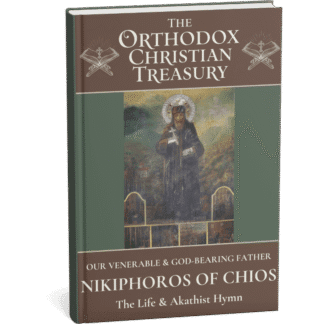
Go Beyond the Synaxarion: A Guiding Star for Troubled Times

The account above is a brief glimpse into the life of a spiritual giant of the Kollyvades. In an age where the pure teachings of the Holy Fathers are often forgotten, arm your soul with the life-giving antidote of True Orthodoxy through our exclusive translation of the life of St. Nikiphoros of Chios.

  • First English Translation: Faithfully translated from the authentic 1907 Greek text, featuring rich translator’s notes that unlock the deep historical and monastic context of his life.
  • New True Orthodox Akathist: An original, soul-stirring hymn composed by our monastery, invoking his protection as a pillar of the Kollyvades renewal against Western innovation.
  • Beautiful Digital Editions: Receive a lovingly designed, full-colour PDF for your prayer corner, alongside a reflowable EPUB for all e-readers.

Purchase the Digital Edition

Posted on

St. Panaretos of Paphos (May 1)

An Icon of St Panaretos of Paphos.

Having drawn all virtue to himself,
Panaretos confirms his name by his deeds.

Saint Panaretos was born at the beginning of the eighteenth century, most probably in Peristeronopigi of Famagusta, where he also became a monk in the local Monastery of Saint Anastasius. We know that in the year 1764 he was the abbot of the Monastery of the Panagia in Pallouriotissa. He ascended the throne of Paphos in 1767 and served as its Hierarch until 1790, when he fell asleep in the Lord.

He lived during those difficult years of the Turkish occupation, a time when fear overshadowed all things and the yoke of slavery weighed heavily. Despite the lack of schools and free education at the time, he was able to acquire a broad education through his own personal efforts and by attending schools maintained by the monasteries. He possessed a broad intellect, which he combined with a strict ascetic life that he diligently concealed. He lived frugally and without luxury, like the poorest Cypriot of his time. He kept vigil for many hours in prayer. He went to confession with humility and celebrated the divine services with sacred dignity. Knowing full well that a man’s greatest victory is to conquer himself—namely, his passions and weaknesses—and in order to remember that the people entrusted to him by God were heavily chained in Turkish slavery, he wore upon his body a brass and an iron chain. By sanctifying himself through the Grace of God, he offered the greatest help to his flock.

As a Metropolitan, he so loved his people that he attended to the problems of all with exceptional care. He utilised both spiritual and material goods in an Orthodox manner, with balance, to the glory of God. He guided the people towards theosis; he celebrated the liturgy, pastored, taught, laboured, and created.

He had a special devotion to Saint Philip (commemorated on the 14th of November) and commissioned a silver reliquary for the Saint’s skull, which is found today in Omodos. At his own expense, an icon of the Apostle Philip was painted. He undertook the expenses for the erection of the church of the Monastery of Saint Anastasius in Peristeronopigi and the painting of the icons for its iconostasis. He renovated the churches in Nikokleia, Drousia, Drymou, Arodes, Theletra, Philousa Kelokedaron, and many other villages. He also renovated the monasteries of Chrysorrogiatissa (1770), the Holy Cross in Omodos, and the Holy Cross in Minthi.

Panaretos of Paphos fully undertook the costs for the publication of the work by the Athenian philosopher Theophilos Korydalleus, “On Generation and Corruption According to Aristotle” (1780). He also assisted financially in the publication of the book by Archimandrite Kyprianos, “A Chronological History of Cyprus” (1788). He was a friend of the Archbishop of Cyprus, Philotheos, who was a highly educated man. He participated in the writing and publication of synodal encyclicals during the tenure of Archbishop Chrysanthos. Owing to his efforts in 1774, local rulers were denounced to the Sultan for maladministration, and in 1783–1784 he travelled with the other Metropolitans to Constantinople, where they succeeded in having the tyrant Hadjibakkis dismissed by the Sultan.

He worked miracles while still in this life. His synaxarion records that he rebuked a priest—who was telling lies and swearing that he had not embezzled money—commanding him to be silent, and the man immediately became mute. Having fallen ill shortly before his death, the priest sent a letter, and his bishop went to him. After the priest repented and asked for forgiveness, his tongue was loosed.

The holy hierarch departed unto the Lord in 1790. Such was the virtue of the saint that he foresaw his death and dug his own grave in the place where the sanctuary of the Cathedral of Saint Theodore in Paphos is located today. He also foresaw that the former Bishop of Karpathos, Parthenios, had arrived at the port of Paphos; he sent for him and offered him hospitality. Parthenios then served his funeral on the very next day. He even became a witness to the healing of a poor paralytic, who had the bishop as his protector, at the very moment they were bringing the relics out from the Metropolis.

The saint had given instructions that he be buried in the garments he was wearing. However, out of love for his spiritual father, his protosyngellos disobeyed him for the first time, and it was then that the chains were discovered, which in certain places had embedded themselves into his flesh. The people of God recognised his holiness immediately after his death, and his official inclusion in the holy calendar of the Church of Cyprus took place during the days of the Cypriot Patriarch of Constantinople, Gerasimos III (1794–1797).

Apolytikion (Troparion), Tone Plagal 1 (5)

Let us praise and glorify the shepherd of Paphos, who lived ascetically in the city as on a mountain, and wisely acquired all the divine virtues as one. Wherefore, as Panaretos, he was shown by God to be wondrous unto the world; and as a God-inspired Hierarch, he fervently intercedeth with God on behalf of all.

Kontakion, Tone 2

Having thy mind illumined by the radiance of the Spirit, O most sacred one, thou wast revealed as a shepherd proven in deed. For through Him thou hast received the divine grace of wonders, and in very deed thou didst become Panaretos, receiving thy name from thy works.

Go Beyond the Synaxarion: The Hidden Life of St. Panaretos

The account above is a glimpse into the life of this “all-virtuous” hierarch. Our exclusive new translation of the saint’s full life reveals the astonishing secret asceticism of a bishop who bore iron chains beneath his vestments and rivalled the desert fathers in the heart of the city.

  • Original Translation: First English translation of his life from the rare 1869 Greek Eklogion.
  • New Akathist Hymn: A soul-stirring prayer composed by our monastery for True Orthodox use.
  • Beautiful Digital Editions: Receive both a richly adorned PDF and a versatile EPUB for all e-readers.

Purchase the Digital Edition — Instant Download

Posted on

Venerable Paphnutius of Borovsk (May 1)

Icon depicting events from the life of St. Paphnutius of Borovsk.

The Venerable Paphnutius of Borovsk, known in the world as Parthenius, lived during the thirteenth and fourteenth centuries. His father was named John. At the age of twenty, Parthenius fled his father’s house in secret and took refuge in a monastery. In the year 1414, he was tonsured a monk in the Monastery of the Protection at Vysotsky in the town of Borovsk, and he was named Paphnutius. Upon the death of the monastery’s abbot, the venerable one was elected to the position. In 1426, he was ordained a priest by Photius, Metropolitan of Kiev. At the age of fifty-one, the venerable one fell gravely ill and retired as abbot, having received the great angelic schema.

Following his recovery, on the feast of the Holy Great Martyr George the Victory-bearer, the 23rd of April in the year 1444, he departed from the monastery and fled to the banks of the Protva River for asceticism and stillness. Before long, other monks followed him, and thus a new monastery was established. The venerable one’s primary concern was the building of a new stone church dedicated to the Nativity of the Theotokos.

The venerable one was an example of simplicity and self-restraint. He possessed the poorest cell, and his food was very simple and minimal. From the monastery’s daily tasks, the venerable one chose the most arduous: he cut and carried wood, and he dug and watered the garden. That which distinguished him, however, was his love for the liturgical life of the Church and for the divine services.

The venerable one foretold his own death. He offered his final prayer, blessed his brethren, and fell asleep in peace in the year 1477.

Apolytikion (Troparion), Tone 4

By the radiance of thy life thou didst enlighten thy fatherland; in prayers and fasts thou wast filled with the gifts of the Divine Spirit. And having struggled well in this temporal life, thou didst open tender mercies to all the sorrowing and wast a defender of the poor. Wherefore, we pray thee, O Father Paphnutius, pray to Christ God that He may save our souls.

Kontakion, Tone Plagal 4 (8)

Enlightened by divine effulgence, O Father, thou didst acquire an ascetic way of life, O venerable one, a most good instructor for monks and a fair adornment of ascetics. Wherefore, the Lord, seeing thy labours, enriched thee with the gift of miracles, for thou dost pour forth healings. And we, rejoicing, cry out to thee: Rejoice, Father Paphnutius!

Go Beyond the Synaxarion: Discover the Full Life of St. Paphnutius

While the synaxarion account above is a window into the spiritual heights of this great clairvoyant wonderworker., our exclusive new translation of his full life invites you to walk alongside St. Paphnutius. Witness his profound humility, his tireless labours, and the grace that allowed him to guide souls to the Kingdom of Heaven.

  • The Complete Life: Translated from the classic Russian Lives of the Saints by St. Demetrius of Rostov.
  • The Akathist Hymn: A moving prayer translated by our monastery, perfect for your personal rule.
  • Beautiful Digital Editions: Receive both a decorated PDF for prayerful reading and a versatile EPUB for your e-reader.

Purchase the Digital Edition — Instant Download

Posted on

Holy Prophet Jeremiah (May 1)

A fresco icon of the Holy Prophet Jeremiah.

The glorious and great Prophet Jeremiah, who prophesied to the people of Israel for forty and one years, was born in Anathoth, where his father Hilkiah was a priest. He distinguished himself as a teacher of love, instructing his fellow countrymen to extinguish the hatred nesting within their hearts and to extend their love even towards their enemies—namely the Chaldeans—to whom he recommended submission in order to avoid the horrors of war. Misunderstood and persecuted as a traitor to his country, he was vindicated by the subsequent capture of Jerusalem by Nebuchadnezzar, which fulfilled his prophecies. He survived the destruction of Jerusalem, over which he wrote his poignant lamentations. Thereafter, he fled to Taphnas in Egypt, where the Egyptians honoured him exceedingly, but he was wickedly put to death by stoning at the hands of his own countrymen.

By his holy intercessions, O Christ God, have mercy upon us and save us. Amen.

Apolytikion (Troparion) of the Prophet, Tone 2

As we celebrate the memory of thy Prophet Jeremiah, O Lord, through his intercessions we beseech Thee: save our souls.

Kontakion, Tone 3

Having purified thy radiant heart in spirit, O great prophet and martyr, O glorious Jeremiah, thou didst receive the gift of prophecy from on high, and didst cry aloud in the lands: Behold, our God, and no other shall be added unto Him, Who, being incarnate, hath appeared on earth.

Megalynarion

Let us extol with hymns the wise prophet-martyr Jeremiah, who was sanctified from his mother’s womb and lamented the fall of the people of the Lord.

Go Beyond the Synaxarion: The Full Life of St. Jeremiah

The synaxarion entry above is a window into the life of this great Prophet. Our exclusive new translation of St. Jeremiah’s full life invites you to journey into his divine calling, his bold rebukes to kings, and his unyielding love for God.

  • The Complete Life: Newly translated from the 19th-century Russian Lives of the Saints by St. Demetrius of Rostov.
  • A Canon for Devotion: A beautiful canon translated by our brotherhood directly from the Greek.
  • Read Anywhere: Instant access to both a beautifully formatted PDF and a versatile EPUB file for all e-readers.

Purchase the Digital Edition — Instant Download