Posted on

The Life of the Holy New Martyr Maria of Crete (+ 1826)

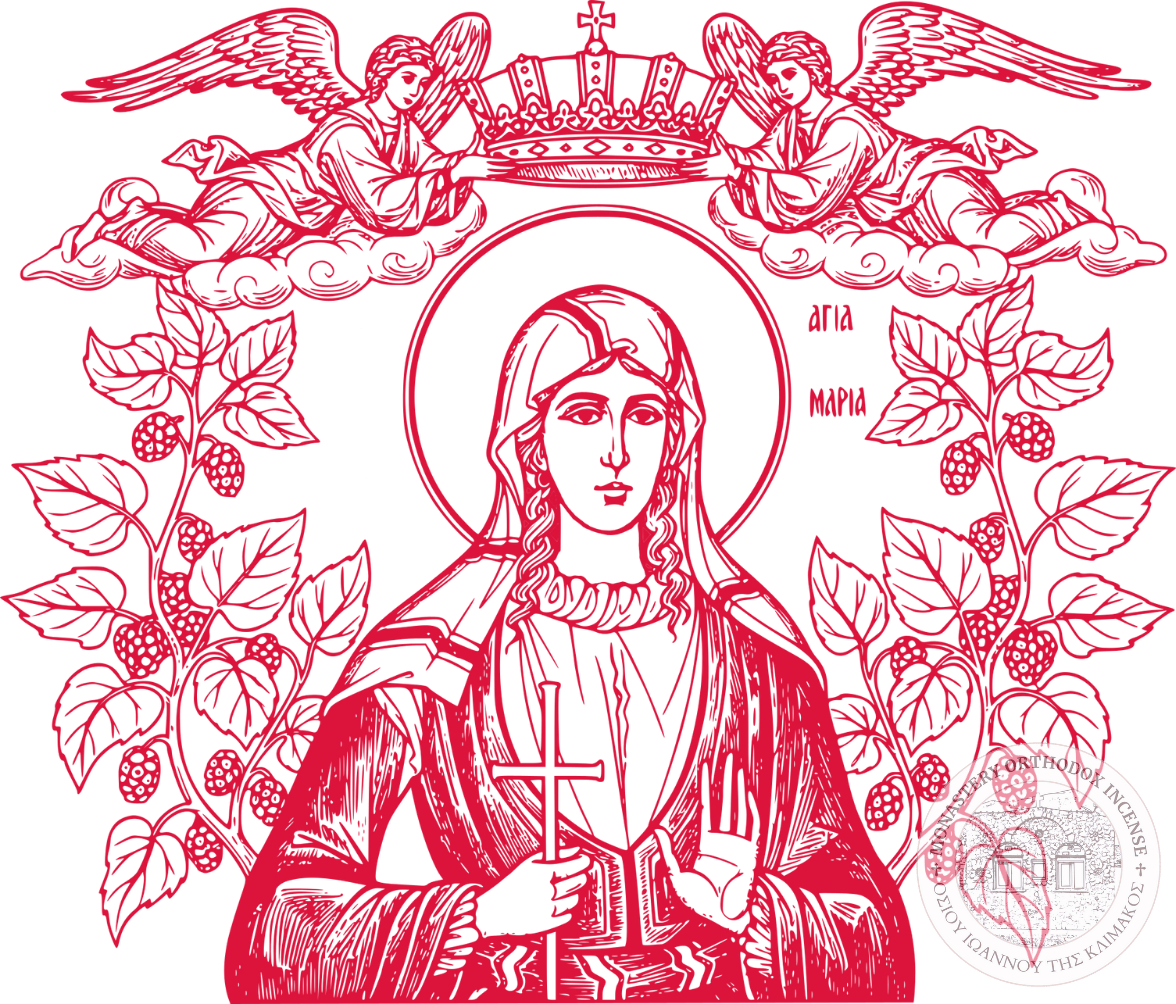
A beautiful sketch icon of the Holy New Martyr Maria (Mary) of Crete being crowned by two angels with a heavenly crown.

CELEBRATED MAY 1st

The fair-virgin New Martyr of the Faith, Maria, surnamed Methymopoula,1 was born in Kato Fourni2 of Meramvellou, Crete, of pious and honourable parents. A certain Turko-Albanian gendarme3 became enamoured of this most chaste maiden, and he exerted every effort to entice her into his abominable lust. Yet, the more he strove, the more the blessed Maria spurned him, regarding him as a repulsive demon and a villain. Therefore, unable to entice her, the impious and bloodthirsty descendant of Hagar resolved to punish her and wickedly put her to death; which indeed he accomplished by means of the arms he bore as a gendarme. Finding Maria one day upon a mulberry tree4 gathering leaves for the nourishment of silkworms, he fired upon her and mortally struck her in the heart. Thus did the all-beautiful bride of the Lord receive the crown of the contest, and, crowned, she departed to meet her longed-for Bridegroom in the heavenly bridal chamber.

Apolytikion (Troparion) – Tone Plagal 1 (Tone 5)

Thou didst keep well the Faith of the Trinity, and faithfully inscribing it with thy blood, thou didst escape all the snares of the enemy. Wherefore, thou didst contest steadfastly as a glorious virgin, O New Martyr Maria. Therefore we all honour thee, beseeching thine intercessions.

Kontakion – Plagal 4 (Tone 8)

Let us crown with melodies and songs the comely virgin among Christ’s steadfast ewe-lambs, Maria the Prize-bearer, who blossomed forth from Crete like a most fragrant flower; and as unto a most sweet garden of virgin maidens let us cry aloud: Rejoice, O newly-contesting Martyr.


1 The name means “the daughter of Methymakis.” It is derived from her father’s surname. In Crete, she is known as Maria Methymakis.

2 Literally “Lower Fourni.” A village in the Lasithi region of Crete, historically known for silk farming.

3 Hellenic: Chorophylax (Χωροφύλαξ). Literally, a “guard of the countryside.” An armed rural constable in the service of the Ottoman occupation.

4 The women of this region would physically climb into the sturdy boughs of the white mulberry trees to harvest sackfuls of leaves.

Posted on

The Life of Saint Batas of Persia

The Passion of the Holy Hieromartyr Batas (+ 4th c.)1

Commemorated on the First of May

The Holy Hieromartyr Batas was from Persia. His ancestors were Christians, and he himself was raised in the Christian faith. Having reached the age of thirty, he left his father, mother, wife, and children, distributed his possessions to the poor, and, departing from his parental home, embraced the monastic life. Striving zealously in the monastic life, he desired to end his life by a martyr’s death. At that time, a persecution was raised against Christians, and when all the monks from that monastery where the saint was struggling had fled, he alone remained. Soon he was seized and brought for judgment before the governor of the city of Nisibis. The latter began to compel him to renounce Christ and worship the sun and fire, but the saint did not obey him, and boldly confessed Christ as the true God. For this, they bound his arms in such a way that from the intense strain, they were dislocated from their shoulder joints. After this, they began to drag the saint along the ground, all the while beating him over his entire body. The holy martyr, after all these torments, reposed for his faith in Christ, being beheaded by the sword.

Footnotes

1 Translated from St. Demetrius of Rostov, Lives of the Saints in Russian (1902-1916 ed.).

A Beautiful, Printable Version for You

The full text of this reading is available for free above.

For those who would like to save, print, or read this life on an e-reader, we have also created a beautifully formatted digital edition. It includes decorative graphics, color artwork, and is designed for easy reading. The A4-sized PDF is perfect for printing and use on large screens, while the EPUB is ideal for e-readers, phones, and tablet devices.

Enter your email below to receive this enhanced version and to subscribe to our monastery’s occasional newsletter. We send updates on new publications and other work from the monastery.

If the form is not visible below, please click here to open it in a new window.

Posted on

The Life of Saint Philosophos of Alexandria

The Holy Martyr Philosophos, Perfected by the Sword (+ 252)1

Commemorated on the First of May

O Philosophos, blessed in name and in deed,

Thou hast truly proven thyself a friend of wisdom.

This great martyr of Christ, Philosophos, was from the region of Alexandria, as was related concerning him by Anthony the Great among ascetics. He completed his martyrdom in the following way.

There was in Alexandria a most beautiful garden, full of delight and sensory charm. Into this garden the tyrant of that time commanded that an adorned couch be placed. Upon it, they laid this holy Philosophos on his back, and bound his hands and feet. Then they brought in a prostitute, who went to the saint. Not only did she attempt to incite the saint to a shameful act with indecent words, but she also embraced him with her defiled hands, and kissed him, and shamelessly touched him.

But the most noble combatant of the Lord, though he was bound, still found a way and a means to save himself from the snares of the prostitute. For first, he closed his eyes so that he would not see her. Then, he bit down upon his tongue with his teeth, and with the unbearable pain he experienced from biting his tongue, he caused the other senses of his body to remain insensible to pleasure. Then, filling his mouth with blood, he spat it upon the face and the garments of the unclean and defiled prostitute, who, seeing the blood flowing like a river, became frightened and drew back.

Having struggled in this manner, the one of great soul was not vanquished, but was victorious; he was preserved passionless by the grace of Christ. For this, he was later beheaded and departed as a crown-bearer to the heavens, where he rejoices with a joy that is eternal and ineffable.2

Footnotes

1 This Life is translated from The Synaxaristes of the Twelve Months of the Year, 3rd Edition, Athens, 1868.

2 The 1868 Synaxaristes includes the following editor’s note for its entry on St. Philosophos: This narrative is also found in the manuscript of the Paradise of the Fathers. In the Synaxaristes of the holy monastery of Dionysiou, the new Coenobium on Mount Athos, this Philosophos is named Justin. The words of Chrysostom, with which he praises the true philosopher, are fitting for this Philosophos: “For what,” he says, “is proper to a philosopher? Is it not to look down on money and glory, and to be superior to envy and every passion? … Such is the philosopher, such is his wealth: he has nothing, and yet he has all things; he has all things, and yet he has nothing.” (Homily 21 on the Epistle to the Ephesians). And Gregory the Theologian also said: “There is a plant in fable that flourishes when it is cut and strives against the blade; and, if one may speak paradoxically of a paradoxical thing, it lives by death, grows by being cut, and increases by being consumed. These things belong to myth and the autonomy of fiction; but to me, it seems the philosopher is clearly such a thing: he thrives in his sufferings, makes his afflictions the material of virtue, and is adorned by their opposites, neither being lifted up by the ‘weapons of righteousness on the right hand’, nor being bent by those ‘on the left’ (cf. 2 Corinthians 6:7), but remains the same man, though not always in the same circumstances; or rather, he is found to be even more proven, like gold in a furnace.” (Oration upon his return from the country). The martyr of Christ Niketas, who suffered under Decius, performed a similar deed. For he too was placed and bound upon a couch and was incited to carnal desire by a prostitute. Therefore, to escape the pleasure, he severed his tongue with his teeth and spat it in the prostitute’s face, as is recounted by Nikephoros [the 14th-century Church historian]. And thus he was victorious, the one who was truly true to his name (“Niketas” derives from nikē, the Greek word for “victory”). See also the eighth chapter of the Politikon Theatron (a 17th-century Greek moral anthology).

A Beautiful, Printable Version for You

The full text of this reading is available for free above.

For those who would like to save, print, or read this life on an e-reader, we have also created a beautifully formatted digital edition. It includes decorative graphics, color artwork, and is designed for easy reading. The A4-sized PDF is perfect for printing and use on large screens, while the EPUB is ideal for e-readers, phones, and tablet devices.

Enter your email below to receive this enhanced version and to subscribe to our monastery’s occasional newsletter. We send updates on new publications and other work from the monastery.

If the form is not visible below, please click here to open it in a new window.