
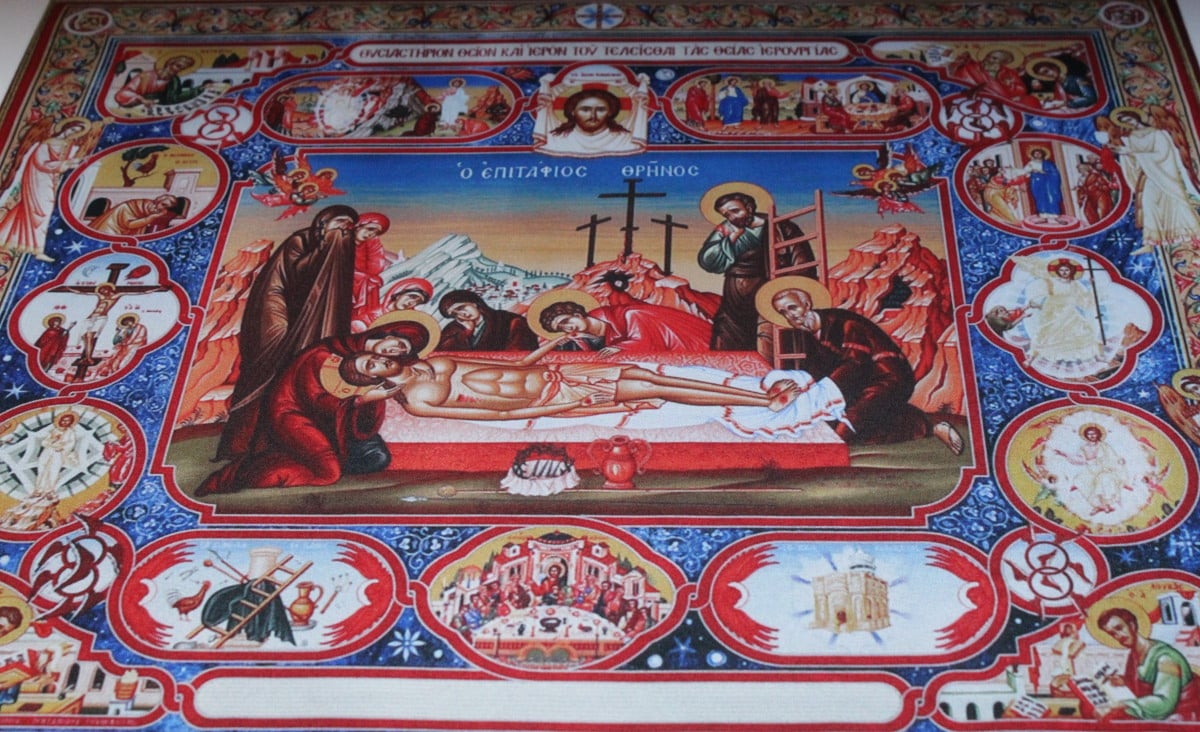
Do you need to buy an antimension for your parish or diocese, but don’t know where to start? This complete guide covers everything you need to know about fabrics, essential rules, consecration, and bulk orders.
Table of Contents
An Antimension Must Be Consecrated Before Use
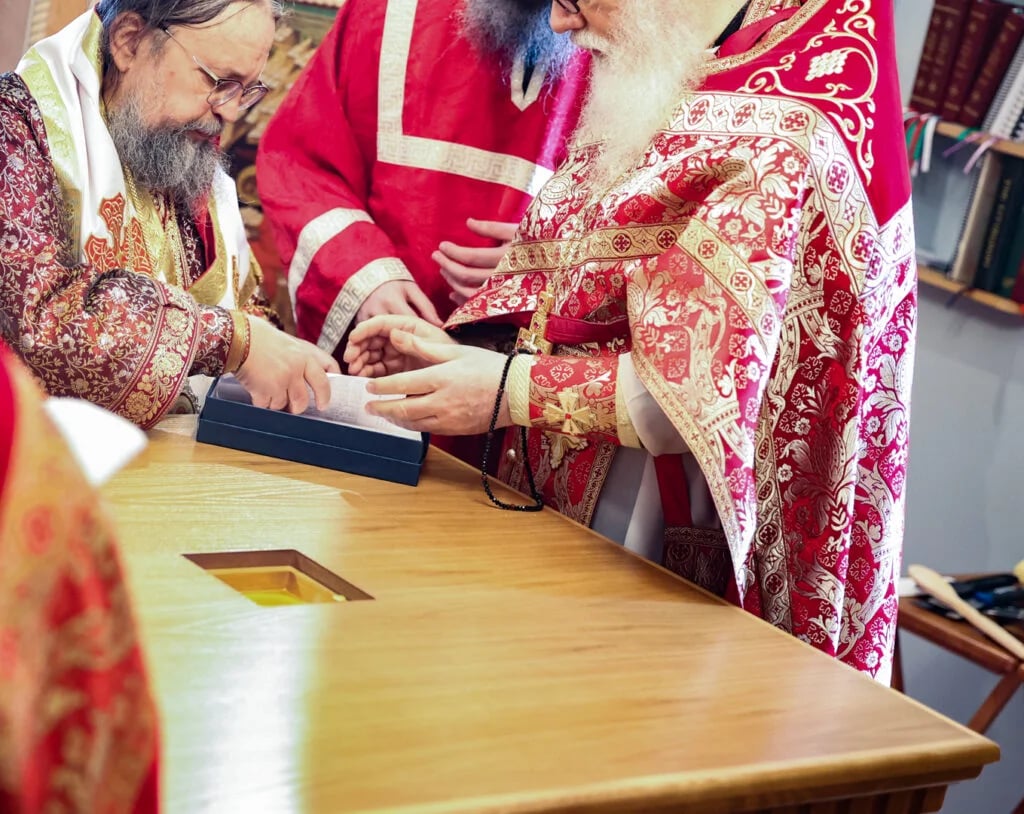
You cannot simply purchase an antimension from a church supply workshop and place it immediately on the holy table for the divine liturgy. Before an antimension can be used liturgically, it must be consecrated.
This happens in one of two ways:
- During the Rite of Consecration of a Temple.
- During a special Rite of Consecration of Antimensia, performed by a bishop during a hierarchical divine liturgy.
Additionally, an antimension must have holy relics of a martyr or martyrs sewn into it before it can be used for the divine liturgy. The only exception to this rule is if the antimension is being used in a consecrated temple that already has holy relics of martyrs sealed within the holy table (agia trapeza) itself.
What Does a Prepared Antimension Contain?
When an antimension is fully consecrated and ready for liturgical use on the altar, it consists of the following elements:
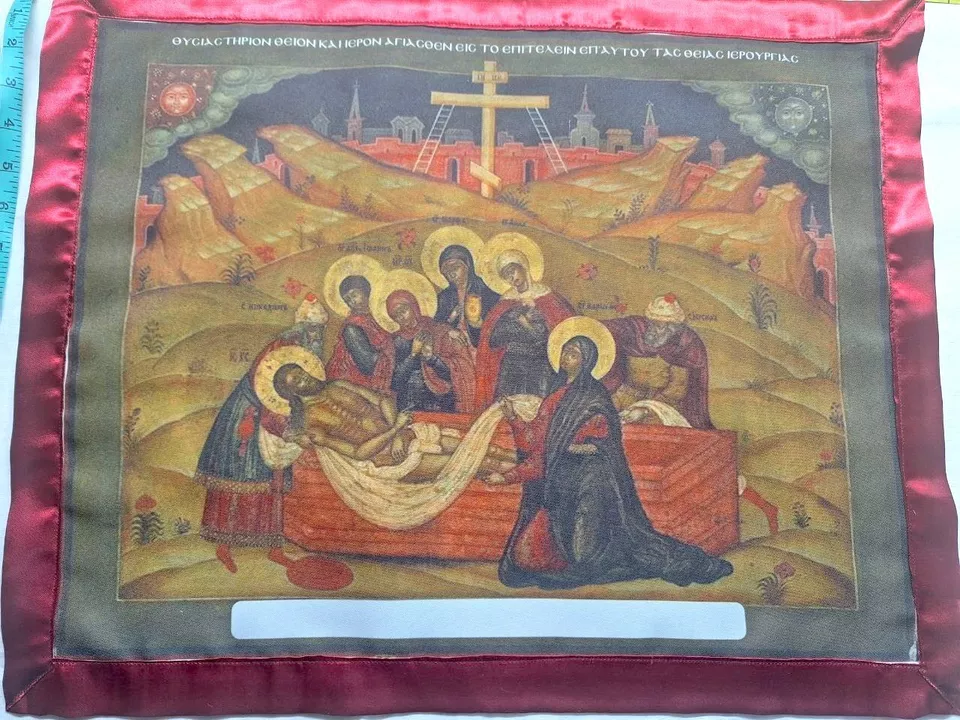
- The Primary Antimension Cloth: A layer of fabric depicting an iconographic representation of the Lamentation at the Tomb of Christ (Epitaphios Thrinos / Επιτάφιος Θρήνος), along with handwritten consecration details (the parish dedication, date, and bishop’s signature) at the bottom.
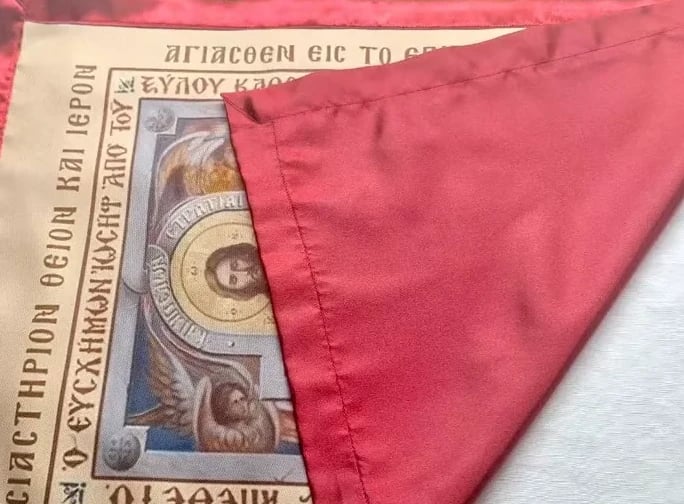
- The Red Backing (Iliton): Almost all antimensia feature a red cloth backing sewn onto the reverse side to protect it. Traditionally, the antimension was wrapped inside a separate red cloth called the iliton (eileton). Today, a quality red backing serves as the iliton itself.
- Optional Separate Iliton: Some priests prefer to use their antimension with a separate, loose iliton cloth. We personally always use a sewn-on iliton backing rather than a separate iliton cloth, though both are perfectly acceptable it remains a matter of personal preference.
- Sewn Relics: Holy relics of martyrs are sewn into the upper border of the red backing cloth (unless the holy table itself is consecrated with relics inside).
What to Expect When Purchasing an Antimension
It is virtually impossible to purchase an antimension that is pre-consecrated and already contains relics. When buying online or from a workshop, you are purchasing the un-consecrated cloth. You will still need to coordinate with your diocese to arrange for its consecration and the insertion of holy relics.
Most workshops do not include a separate iliton cloth by default.
When purchasing, suppliers typically offer two options:
1. Buying an Antimension With a Red Backing Pre-Sewn
This is the standard option for parish use. On your end, you will simply need to arrange for your bishop to consecrate the antimension and provide the relics to be sewn into the top border.
2. Buying an Antimension Without a Red Backing
Ordering an unbacked antimension is essential if the cloth is intended for use during the Rite of Consecration of a Temple.
During a temple consecration, the antimension comes into direct contact with the holy oils and chrism (myron) used by the bishop. If a backing is attached during this rite, the dyes from the red fabric will bleed into the antimension cloth and permanently stain it. Therefore, red backings should always be sewn on after an antimension has been consecrated during a church consecration.
(Note: This warning only applies to temple consecrations. The standard Rite of Consecration of Antimensia performed during a hierarchical liturgy does not involve heavy oils, so pre-sewn backings carry no risk of color bleeding during that rite.)
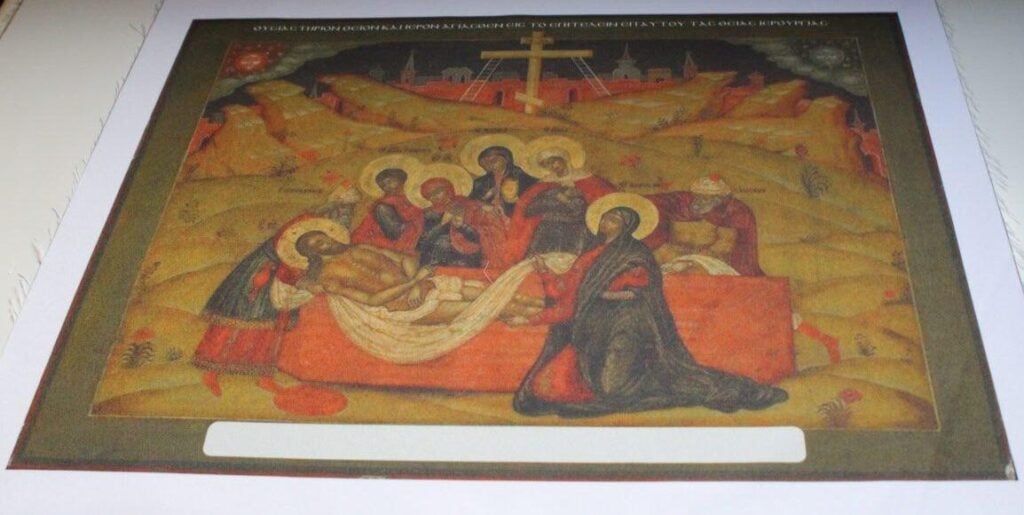
An unbacked antimension is also ideal if a priest prefers to serve with a separate iliton cloth, rather than a sewn-on iliton backing. In that case, the antimension simply needs to be neatly hemmed around the edges to prevent fraying. An unbacked option also allows a parish seamstress or presbytera to add a personal touch by hand-sewing a custom backing onto the cloth later.
Key Features & Materials to Look For
Fabric Properties
The fabrics used for both the antimension and its backing should be firm enough to hold clean, sharp fold lines. This ensures the cloth stays folded securely does not lose its shape when it is not being used. The material must also be durable enough to withstand years of continuous weekly use.
Whenever possible, choose a smooth and silky fabric for both the antimension and the red backing. In addition to being silky and smooth, the backing should be heavy and non-porous. Smooth surfaces allow the serving priest to sweep holy particles (merides) with the holy sponge more efficiently. Smooth fabric is superior in every practical aspect, which is why it is the only type of antimension fabric we recommend. In our workshop, we print all of our antimensia on smooth, low porosity synthetic silk for this exact reason.
Iconography

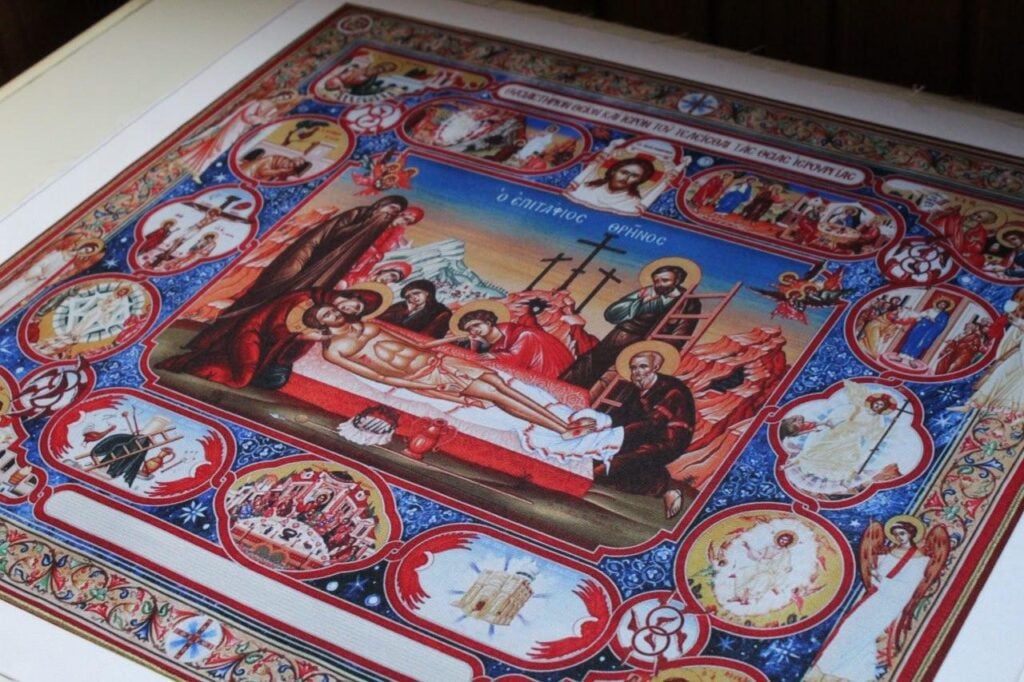
Antimensia fundamentally depict the Epitaphios Thrinos (the Lamentation at the Tomb). Very ancient Byzantine designs sometimes featured the Akra Tapeinosis (Extreme Humility) icon, which is also deeply traditional. Other icons may adorn the main central scene, such as the Four Evangelists, cosmic elements like the shrouded sun and moon, or scenes depicting key events from the Economy of our Salvation.
Language
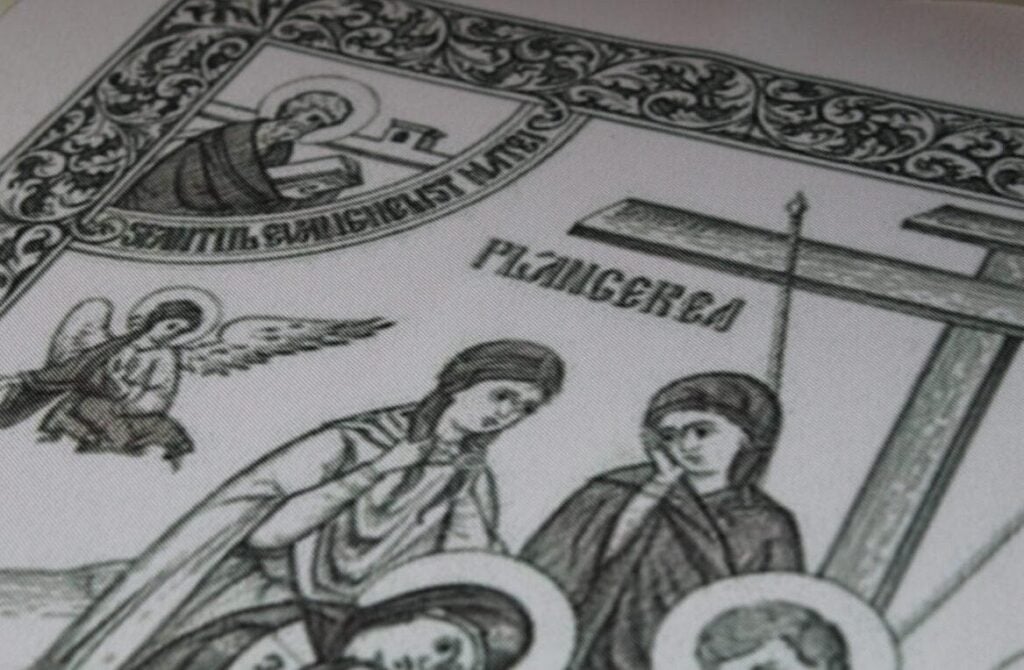
An antimension does not have to be in the language you perform the divine services in. The iconographic inscriptions and the handwritten consecration text can be in Greek, Church Slavonic, English, Romanian, or any language. A Greek parish can use an antimension printed in Church Slavonic or English, and vice-versa.
Color vs. Traditional Black & White
Historically, all antimensia were printed in black ink on white fabric due to early printing methods.
Color antimensia have become very popular in the last century. One benefit of them is that holy particles are easier to see against a colored background—which might be important to the serving priest if he serves in a sanctuary without much lighting. Those seeking a more classical, traditional aesthetic often prefer the older black-and-white style, such as our restored 1870 Athonite Antimension. Both options are totally acceptable.
Size & Altar Proportions
Before purchasing, measure your holy table to determine the maximum height and width allowed for your antimension. Always leave at least an inch between the bottom edge of the unfolded antimension and the front edge of the holy table—an antimension must never hang over the edge.
If you are a priest equipping a new altar, ensure that other altar items do not crowd the space:
Historical Context on Tabernacles:
Altar tabernacles (artophoria) have grown quite large and ornate in modern times. However, in Greece until the late 1800s, tabernacles were small, simple containers sitting on the holy table—often no larger than a pear. It is not impious to use a small and simple tabernacle, as this is how they traditionally were for centuries.
While gospel books, tabernacles, candleholders, and oil lamps can all be purchased in smaller sizes to fit a compact altar or house church, the antimension must always be large enough for the priest to serve comfortably. So if you have a smaller holy table, buy your antimension first, and arrange the rest of your altar items around it.
I Want To Buy an Antimension for My Parish or Mission Altar
If your diocese has asked you to buy an antimension for your parish:
- Select a Pre-Sewn Red Backing: Since standard consecration rites outside of a church consecration do not use heavy oils, you can safely purchase an antimension with the backing already attached. Every antimension in our Antimension Collection offers a pre-sewn heavy red satin backing option at checkout.
- Select the Design and Size Best Suited For You:
- For a classic, universally recognized layout, choose an antimension like our classic Four Evangelists Antimension (approx. 20″ × 17″ / 51 × 43 cm with backing).
- For a design that highlights the lamentation and mourning of the Epitaphios, choose an antimension like our Sun & Moon Antimension (approx. 24″ × 17.5″ / 61 × 44 cm with backing), which portrays creation’s reaction to the Crucifixion.
- For rich colors and iconography celebrating the Economy of Our Salvation, choose an antimension like The Divine Economy Antimension (approx. 22″ × 19″ / 56 × 48 cm with backing).
- If you want something original for your altar, choose an original design like the Angelic Witness Antimension (approx. 27″ × 17″ / 68.5 × 43 cm with backing), which shows Christ entombed.
- For a historical Athonite aesthetic, choose an antimension like our monochrome 1870 Athonite Antimension (approx. 20.25″ × 18.25″ / 51.5 × 46.5 cm with backing), which is a faithful reproduction of an Athonite classic.
- Coordinate Consecration Details: Discuss with your chancellor or bishop how the cloth will be consecrated and who will provide and sew in the necessary holy relics.
Products by Category
-
![Four Evangelists Antimension]()
Four Evangelists Antimension
Price range: €38,99 through €49,99 -
![Angelic Witness Antimension]()
Angelic Witness Antimension
Price range: €44,99 through €49,99 -
![Sun & Moon Antimension]()
Sun & Moon Antimension
Price range: €41,99 through €49,99 -
![Divine Economy Antimension]()
Divine Economy Antimension
Price range: €44,99 through €58,99 -
![1870 Athonite Antimension]()
1870 Athonite Antimension
Price range: €36,99 through €49,99



I Want To Buy Antimensia for a Temple Consecration
If you are buying antimensia for an upcoming church consecration:
- Order Unbacked Antimensia Only: Ensure the cloths have no pre-sewn backings to prevent chrism oils from causing the dye to bleed onto the front of the antimension during the rite. Every design in our collection can be ordered in an unbacked format specifically for church consecrations.
- Determine Quantities & Volume Pricing: A temple consecration is an ideal opportunity for a diocese to consecrate multiple antimensia at once. Confirm with your ruling hierarch how many pieces he wishes to consecrate during the service. If you order from our website, automatic discounts apply to your antimensia as you add more to the cart, without you having to enter any discount codes. Read more about how our automatic bulk discounts work in our wholesale policy. Unbacked antimensia can be stored consecrated and have backings sewn on individually as needed over time.
I Want To Buy Bulk Antimensia for My Diocese
If you are representing a chancery or episcopal office:
- Verify Signature Space: Ensure your ruling hierarch is satisfied with the layout and the amount of open space provided at the bottom of the design for his handwritten inscriptions and signature.
- Custom Print Runs: When ordering in bulk, workshops can often accommodate custom prints—including pre-printing specific jurisdictional headers, local languages, or proprietary diocesan plate artwork. You can contact our workshop to discuss custom diocesan print runs.
- Bulk Pricing: Discuss with the antimensia workshop their bulk discounts for large orders. When you order in bulk from our website, bulk discounts automatically apply in your shopping cart without you having to do anything—the more antimensia you have in your cart, the greater the discount. You can read more in our wholesale ordering policy.
- Plan Consecration Methods: Confirm whether your bishop intends to consecrate the batch during an upcoming temple consecration (requiring unbacked cloths) or during a hierarchical divine liturgy (where pre-backed cloths can be used for convenience).
Conclusion
The antimension is a sacred object in Orthodox liturgical life, serving as the consecrated foundation for the celebration of the eucharist. Whether you are outfitting a small mission table or preparing for a cathedral consecration, selecting a well-crafted antimension—made from durable, smooth, fabric with a beautiful and reverent design—ensures that the holy mysteries are served with dignity, order, and reverence for generations to come. Explore our complete Antimension Collection to choose the design best suited for your altar.